Innhold
- When seconds determine survival
- The weight of watching over others
- When automation betrays human judgment
- The economics of impossible choices
- Evolution under fire creates new challenges
- Cultural approaches shape life-or-death decisions
- The human future of machine-speed warfare
- Guardians of the threshold
Captain Sahar Saudyan was playing Jungle Speed with her teammates just hours before she would make the ultimate sacrifice. The 21-year-old Iron Dome operator had no way of knowing that October 7, 2023, would transform from routine card games into the largest coordinated attack Israel had ever faced—or that she would become the first Iron Dome operator ever killed in combat while restocking interceptor missiles to protect her homeland. Her final text to family read: “Take care of yourselves, everything is OK, I’m protecting you.”
This is the reality of modern air defense: split-second decisions carrying the weight of hundreds of lives, made by young operators who transition seamlessly from casual conversation to life-or-death tactical choices in mere moments. Behind the sophisticated technology and impressive statistics lies an intensely human story of courage, sacrifice, and the profound psychological burden of serving as civilization’s last line of defense against incoming death.
When seconds determine survival
The mathematics of air defense decision-making are brutally simple: hypersonic missiles travel at Mach 5+ speeds, giving operators as little as 30 seconds from detection to engagement.
Consider the crushing weight of these moments. A Ukrainian Patriot operator, with minimal training time, must identify, track, and engage a $10 million hypersonic missile traveling faster than anything in their training scenarios. The operator has roughly the time it takes to read this sentence to make a decision that could save or doom hundreds of civilians sleeping in Kyiv below.
The human element becomes even more critical when technology fails. One Iron Dome battery commander described a terrifying moment when two interceptor missiles missed an incoming rocket heading toward Tel Aviv’s Azrieli Towers. With just four seconds until impact and hundreds of potential casualties, a sudden wind shift sent the missile harmlessly into the sea. “I stood up and shouted, ‘There is a God!’” the commander recalled.
The weight of watching over others
What transforms air defense operators from technicians into guardians is their intimate connection to those they protect. A U.S. Air Force drone pilot described this psychological burden: “Flying an RPA, you start to understand people in other countries based on their day-to-day patterns of life… You become immersed in their life. You feel like you’re a part of what they’re doing every single day.”
This emotional investment creates extraordinary pressure when systems approach their limits. During Hamas’s October 7 attack, Iron Dome faced an impossible choice: with 5,000 rockets launched in the initial barrage, operators had to decide which areas to protect when interceptor supply simply couldn’t match incoming volume. The system’s “unknown saturation point” was brutally revealed as remaining rockets penetrated defenses, forcing operators to make triage decisions about entire communities.
The personal cost extends beyond combat. Iron Dome operators, mostly young soldiers, have nicknamed their system “the toaster” due to health concerns about prolonged radar exposure. Yet they continue operating because, as one technician who risked his life fixing a battery under fire explained: “We were just doing our jobs and we are happy that the intercepting missile managed to thwart the Grad rocket fire.”
When automation betrays human judgment
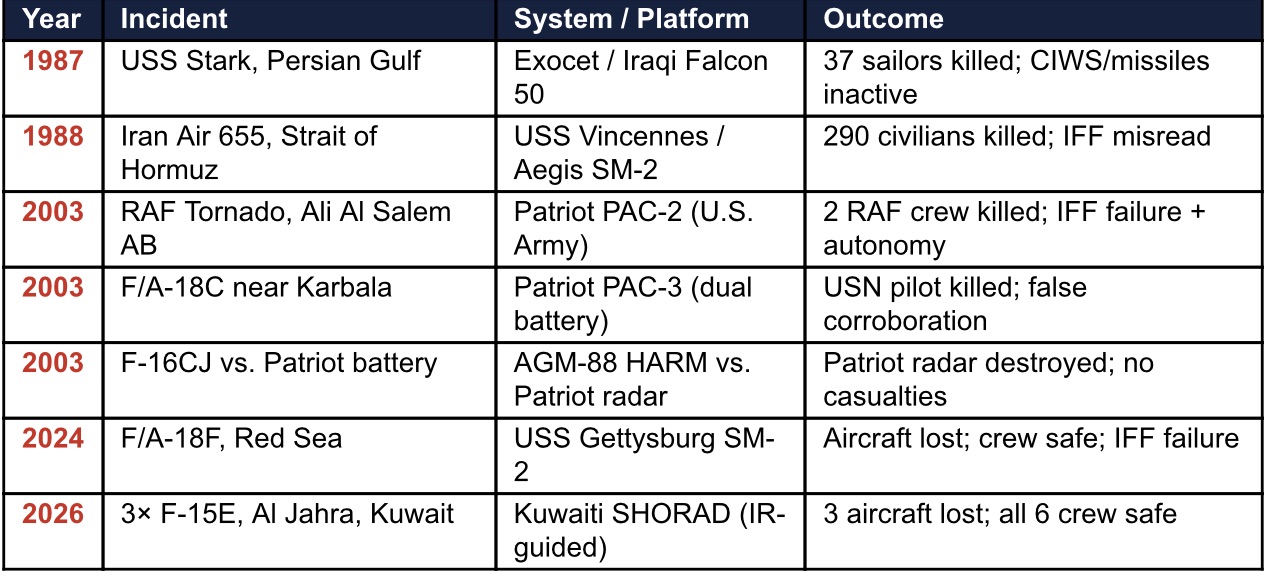
The deadliest air defense failures occur when operators trust technology over their own instincts. Dr. John Hawley, an engineering psychologist with 35 years of Patriot system experience, predicted the tragic 2003 friendly fire incidents years before they occurred: “Those outcomes had been in the card deck, so to speak, ever since they first flipped the engagement mode switch to automatic.”
In Iraq, Patriot operators faced a cruel paradox: 41,000 coalition aircraft sorties versus only 9 enemy ballistic missiles created a 4,000-to-1 friendly-to-enemy ratio, yet operators were trained to trust automated target identification. When Lieutenant Nathan White’s F/A-18 was misidentified as a ballistic missile, the system’s recommendation to fire was approved “without independent scrutiny.” His sister later said: “It didn’t have to happen. Our own people killed him.”
The human psychology behind these failures reveals a fundamental challenge: Major General Vane captured it perfectly: “How do you establish vigilance at the proper time? 23 hours and 59 minutes of boredom followed by one minute of panic.” This cognitive burden—maintaining perfect alertness during endless quiet periods while being ready to make flawless decisions in seconds—represents perhaps the most demanding role in modern warfare.
The economics of impossible choices
Behind every engagement decision lies a stark economic reality that operators must process instantaneously. Ukrainian forces learned to reserve expensive missiles for high-value targets, using cheap guns against Iranian Shahed-136 drones costing $20,000 each— a tactical adaptation that prevented expensive systems from being overwhelmed by cost-asymmetric attacks.
The financial stakes are staggering: a single GMD interceptor costs $75 million, while the new Next Generation Interceptor will cost $487 million per unit. Iron Dome operators making split-second decisions know their $50,000 Tamir interceptors represent a favorable exchange against incoming rockets, but Patriot operators face the psychological pressure of firing $3.7 million missiles at targets that may cost a fraction of that amount.
This cost consciousness directly affects tactical decisions. When Saudi Patriots engaged Houthi missiles, operators typically fired two interceptors per target, knowing each engagement represented an $8.6 million commitment. The psychological weight of potentially “wasting” such resources while people’s lives hang in the balance creates an additional layer of stress that civilian decision-makers rarely consider.
Evolution under fire creates new challenges
Modern air defense operators face threats their predecessors never imagined. Sweden’s military recently demonstrated control of 100 drones simultaneously, while Iran’s April 2024 attack on Israel involved approximately 300 drones—representing the largest drone attack in history. Operators must now process information at machine speed while maintaining human judgment about target prioritization and rules of engagement.
The Pentagon’s 2024 testing at Yuma Proving Ground revealed a sobering reality: “No one capability, whether kinetic or non-kinetic, could really just beat this kind of attack profile.” This forces operators into increasingly complex multi-layered decision trees where they must coordinate everything from directed-energy weapons costing under $3 per shot to multi-million-dollar interceptor missiles.
Artificial intelligence is transforming the operator’s role from reactive to predictive. GDIT’s DOGMA system provides 30-second lead time for highly maneuverable threats while maintaining communication disruption of only 33 milliseconds when switching between networks. Yet this technological evolution creates new psychological challenges: operators must learn to trust AI recommendations while maintaining healthy skepticism about automated systems that may fail at critical moments.
Cultural approaches shape life-or-death decisions
How operators make these split-second choices varies dramatically across military cultures. American doctrine emphasizes “mission command” with tactical flexibility at lower levels, while Russian systems maintain highly centralized control with limited subordinate initiative. These philosophical differences directly impact response times and tactical effectiveness under pressure.
Israeli operators benefit from a culture that encourages innovative adaptation and rapid technological integration. Iron Dome’s 97% success rate in 2024 operations reflects not just advanced technology but a military culture that empowers young operators to propose tactical improvements. The system’s evolution from 85% effectiveness in 2012 to near-perfect performance today demonstrates how cultural factors affect technological development.
Chinese military doctrine emphasizes collective decision-making and political reliability alongside military competence, creating different psychological pressures for operators who must balance tactical effectiveness with political considerations. Russian operators in Ukraine have struggled with over-centralization that prevents rapid tactical adaptation— a cultural limitation that technology alone cannot overcome.
The human future of machine-speed warfare
As threats become faster and more complex, the human operator’s role is evolving rather than diminishing. Modern cockpits have transformed from analog “knobs and dials” to sophisticated multifunctional displays, but human judgment remains essential for “gray or ambiguous situations” that automated systems cannot handle.
Training has adapted accordingly. Rather than “death by PowerPoint,” modern air defense training emphasizes scenario-based experiences that challenge operators beyond routine procedures. Australian recruit Jordan Keane described the transformation: “I failed my initial fitness test… Mentally, I hit rock bottom,” before finding the inner strength that led to breakthrough performance. This resilience becomes critical when operators face real-world situations where lives depend on their decisions.
The psychological demands continue intensifying. Modern operators must transition rapidly between high-stakes combat operations and normal life—what one drone pilot described as stepping “from doing a mission and go off to my child’s soccer game” with potentially “as little as ten minutes” between worlds. This context switching represents a unique cognitive challenge that traditional military roles never required.
Guardians of the threshold
The future of air defense lies not in replacing human operators but in optimizing the partnership between human judgment and machine capability. As hypersonic weapons and drone swarms proliferate, operators will need to make increasingly complex decisions at machine speed while maintaining the ethical and strategic awareness that only humans can provide.
Captain Saudyan’s sacrifice represents the ultimate expression of this human dimension. Faced with overwhelming odds and knowing the risks, she chose to restock interceptor missiles rather than seek safety. Her decision—repeated daily by air defense operators worldwide—reflects the profound human commitment that technology alone cannot replicate.
These split-second guardians stand at the intersection of humanity’s most advanced technology and our most basic need for protection. They are the final arbiters in a world where milliseconds separate safety from catastrophe, where billion-dollar systems ultimately depend on the judgment, courage, and sacrifice of young operators who hold the power of life and death in their hands. Their story—part technical mastery, part human drama—represents one of modern warfare’s most demanding and critical roles, where excellence isn’t just professional achievement but the difference between protection and annihilation for thousands of innocent lives.