Innhold
Hypersonic glide vehicles (HGVs) have reshaped the missile defense debate, but the conversation rarely descends to the physical reality of what makes them hard to intercept. Speed is the headline; the actual problem is geometry, altitude, and timeline compression. An HGV flying at Mach 12 at 60 kilometers altitude isn’t simply a faster ballistic missile — it occupies a flight corridor that most existing interceptors were never designed to reach, at maneuver rates that defeat the predictive algorithms ground-based fire control systems depend on.
What an HGV Actually Does
A hypersonic glide vehicle is launched on a ballistic rocket to high altitude, separates from its booster, and then glides unpowered through the upper atmosphere at speeds between Mach 5 and Mach 25. The key distinction from a ballistic missile is the trajectory: a ballistic warhead follows a predictable parabolic arc, peaking above the atmosphere and re-entering steeply. An HGV flies a flatter, skip-glide profile — remaining in the 40–100 km altitude band (the “near-space” layer) for most of its flight, maneuvering laterally to defeat tracking prediction, and arriving at a shallower angle with a compressed terminal phase.
Russia’s Avangard operates at approximately Mach 20–27 on a boost-glide trajectory from a modified SS-19 (UR-100N) ICBM. China’s DF-ZF HGV, delivered by the DF-17 medium-range ballistic missile, operates at roughly Mach 10 with a published range of 1,800–2,500 km. The U.S. Common-Hypersonic Glide Body (C-HGB), shared between the Army’s Long-Range Hypersonic Weapon and the Navy’s Conventional Prompt Strike program, operates in the Mach 8–17 range depending on mission profile. All three exploit the same fundamental physics: the 40–100 km altitude band where atmospheric density is high enough to generate lift but low enough to allow sustained hypersonic flight.
Why Existing Interceptors Fall Short
The 40–100 km altitude band is a systematic gap in Western missile defense architecture. Each major interceptor tier was optimized for a different threat at a different altitude:
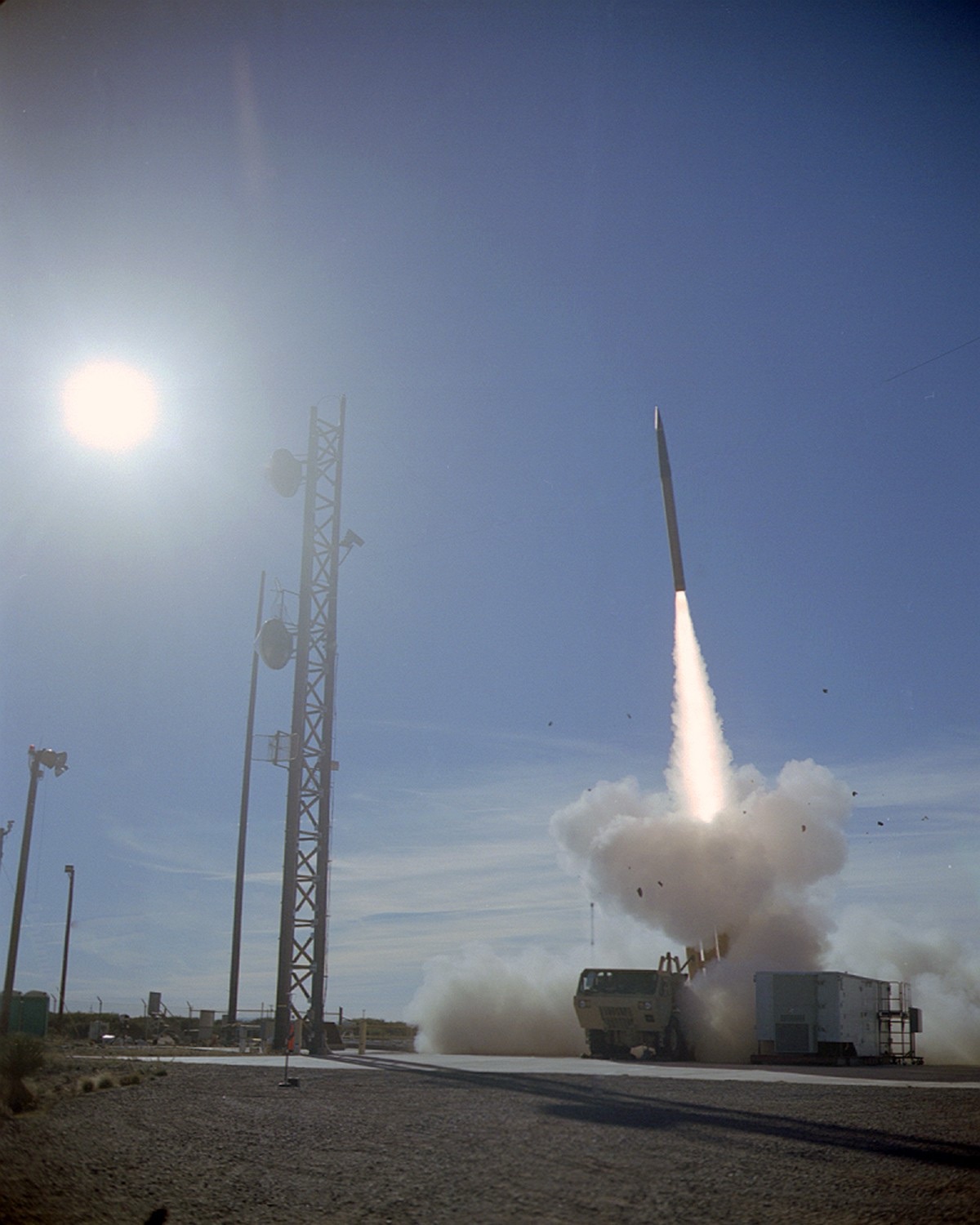
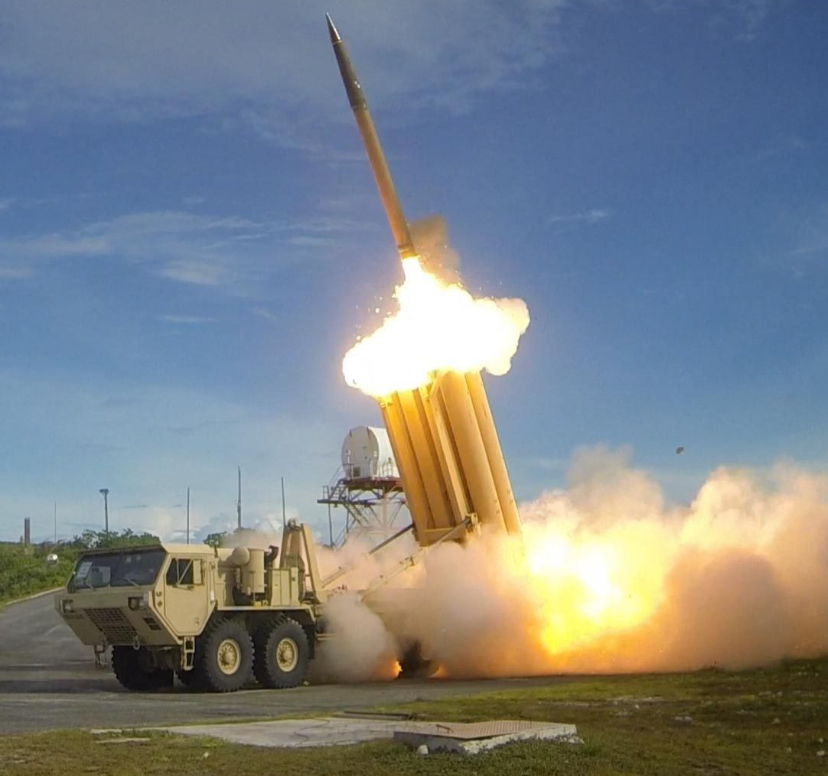
THAAD (Terminal High Altitude Area Defense) engages targets at 40–150 km altitude, but was designed for ballistic missiles following predictable descent profiles. Its X-band radar and fire control can track HGVs, but the engagement geometry requires predicting where the target will be several seconds into the future — and an HGV can execute lateral maneuvers of several kilometers that defeat the intercept point calculation. THAAD can engage HGVs under limited conditions, but the maneuverability advantage strongly favors the offense.
SM-3 (Standard Missile-3) is an exo-atmospheric interceptor optimized for the midcourse phase of ballistic trajectories above 100 km. HGVs fly below this ceiling for most of their flight envelope, making SM-3 geometrically unable to intercept them in the endo-atmospheric phase where they spend the majority of their time.
PAC-3 MSE has a ceiling of approximately 35–40 km and is optimized for theater ballistic missiles during terminal descent and cruise missiles. HGVs crossing this altitude band at terminal approach are at Mach 8+ and have already completed most of their maneuvering — the engagement window is measured in single-digit seconds, well beyond PAC-3’s kinematic envelope for an HGV-class target.
SM-6 occupies an intermediate role. Its Block IA variant, tested against a simulated HGV target in 2023, has been credited with limited HGV intercept capability at terminal approach — but SM-6 is primarily a sea-based system, and its HGV intercept capability applies only to a narrow terminal window, not the full glide phase.
The result is a structural gap. An HGV at 60 km altitude, maneuvering at Mach 12, is simultaneously above PAC-3, below SM-3, and too maneuverable for THAAD’s fire control prediction to guarantee an intercept. This is not a gap that better software or more radar power can close — it is a kinematic problem that requires a different class of interceptor.
The Sensor Problem Comes First
Before any interceptor can engage an HGV, the weapon must be detected, continuously tracked, and kept in sensor custody through an unpredictable flight profile. This is harder than it sounds.
Ground-based radar — including the AN/TPY-2 (used with THAAD) and Aegis’s SPY-6 — can track HGVs, but faces geometric limitations. An HGV at 60 km altitude traveling at Mach 12 from 2,000 km out is beyond the radio horizon of most ground-based radars until the final minutes of flight. By the time a single ground radar has established firm track, the engagement window for existing interceptors may already have closed. The fire control problem requires knowing where the HGV will be several seconds in the future — and that requires track quality that ground-based radar alone cannot consistently provide against a maneuvering target.
The solution is persistent space-based tracking. The U.S. Space Development Agency’s (SDA) Tracking Layer — a constellation of low-Earth-orbit satellites equipped with wide-angle infrared sensors — is specifically designed to maintain HGVs in continuous track from boost phase through glide. Phase 0 satellites launched in 2023; the constellation is expanding toward an operational baseline of 28+ satellites by the late 2020s. The legacy SBIRS (Space-Based Infrared System) provides boost-phase detection and early-warning cueing but lacks the tracking fidelity for fire control.
For European NATO members, the sensor picture is starkly different. No European nation operates satellites with HGV tracking capability. The alliance depends entirely on U.S. sensor data for any HGV-related fire control — and the data links, latency requirements, and command authority arrangements for translating that data into a European interceptor cue are largely untested in this threat context.
Emerging Intercept Programs
Glide Phase Defense (GPD)
The most direct U.S. response to the HGV intercept gap, GPD (formerly the Glide Phase Interceptor, GPI) is a Missile Defense Agency program to develop a dedicated ground-based HGV interceptor. Phase 1 contracts were awarded to Northrop Grumman, Raytheon Technologies, and L3Harris for competing concept designs. The program targets intercept of HGVs during the glide phase — the most challenging engagement geometry — requiring an interceptor capable of operating in the 40–100 km band against maneuvering targets at Mach 5+. Initial fielding is not expected before the early 2030s.
Arrow-4
Developed jointly by Israel’s Missile Defense Organization and the U.S. Missile Defense Agency, Arrow-4 is engineered from the start with HGV engagement geometry in mind, targeting both advanced ballistic missiles and glide vehicles. The program sits above Arrow-3 (exo-atmospheric ballistic intercept) in the defensive architecture, filling the glide-phase intercept role that no current Israeli or U.S. system addresses well. Arrow-4 is in active development as of 2026; no public IOC timeline has been announced.
SM-6 Block IA
The SM-6 upgrade is the nearest-term U.S. HGV intercept capability in service, limited to terminal-phase engagement from Aegis-equipped ships. Its role is narrow: an HGV approaching a maritime target, or a coastal installation within range of a forward-deployed Aegis ship, can be engaged in the final seconds of flight. Against a continental target or in a pure land warfare context, SM-6’s HGV contribution is marginal.
What Directed Energy Offers — and Doesn’t
High-energy laser intercept of HGVs is frequently cited as a long-term solution. The physics impose severe constraints. A laser weapon requires sustained dwell time on a target to transfer enough energy for structural failure. At Mach 12 and 60 km altitude, a 100-kilowatt ground-based laser would need to propagate through 60+ km of atmosphere with attendant beam spreading, thermal blooming, and atmospheric turbulence, while tracking a target moving at 4 km per second. The dwell times required are currently incompatible with the closing speed.
Space-based laser intercept in the boost or early glide phase — before the HGV has accelerated to full speed — is theoretically more tractable, since the engagement occurs above most of the atmosphere. But the orbital infrastructure required, at the survivability and power levels needed for operational use, does not exist in any nation’s near-term program. Directed energy may eventually supplement kinetic HGV defense at specific engagement geometries, but it does not offer a near-term path around the kinematic problem.
The Left-of-Launch Alternative
Kinetic intercept of an HGV in flight is the hardest problem in missile defense. The doctrinal response is to move the engagement earlier — “left-of-launch” — by targeting the weapon or its support infrastructure before it fires. This encompasses:
Kinetic strike against the launcher or transport-erector-launcher (TEL) during a conflict, drawing on real-time targeting intelligence. This is the most direct option but depends on the ability to locate mobile launchers under contested ISR conditions.
Cyber and electronic warfare targeting the guidance system, pre-launch command links, or maintenance and fueling infrastructure. HGV guidance systems are sophisticated and presumably hardened, but the broader launch chain — satellite uplinks, ground control systems, communication nodes — may offer targets of opportunity.
Counter-space operations against adversary targeting satellites that feed in-flight guidance updates. Degrading the HGV’s navigation accuracy may not prevent the weapon from arriving, but it can reduce the probability of a precision strike on a hardened point target.
Left-of-launch is not a substitute for terminal defense — it depends on warning time, targeting data, and political authority that may be unavailable in a crisis — but it is increasingly central to U.S. IAMD doctrine precisely because the kinetic intercept problem in the glide phase is so difficult.
The European Gap
No European nation has a fielded or near-term planned HGV interceptor capability. The European Sky Shield Initiative (ESSI), while expanding medium-range and long-range missile defense across 24 member states, does not include any system designed for the HGV engagement envelope. Germany’s Arrow-3 acquisition provides exo-atmospheric ballistic missile defense; IRIS-T SLM covers the medium-altitude band; Patriot PAC-3 MSE addresses theater ballistic and cruise threats at terminal approach. All three tiers miss the HGV glide corridor — the 40–100 km zone where the weapon spends most of its flight.
European security against HGV threats currently rests on three pillars: U.S. extended deterrence through the threat of nuclear or conventional retaliation in kind, U.S. sensor data shared under NATO frameworks, and the political-military deterrent weight of NATO collective defense. Interceptor-based defense against HGVs on European territory is a gap that will not close before the early 2030s at the earliest — and only if programs like GPD and Arrow-4 proceed on schedule and eventually include variants deployable under NATO or bilateral agreements.
For Norway, neither NASAMS, IRIS-T SLM, nor Patriot PAC-3 MSE addresses HGVs. Norway’s pending long-range system decision — with Patriot the leading candidate — would add a theater ballistic missile defense layer but not an HGV-specific one. The sensor contribution is where Norway can act sooner: advanced radars integrated into NATO’s air picture contribute to the tracking network on which any future intercept attempt must depend, and Norwegian geography — covering the Barents Sea approaches and the trajectory corridors from Russian launch sites — makes those radars disproportionately valuable to alliance sensor coverage.
What Would Close the Gap
A credible HGV defense architecture requires four elements working together:
- Persistent space-based tracking across the full glide trajectory — the SDA Tracking Layer is the leading program, with operational capability building through the late 2020s
- A dedicated glide-phase interceptor with the kinematic performance to reach the 40–100 km band and engage maneuvering targets — GPD and Arrow-4 define the early-2030s window
- High-speed fire control data links capable of translating space sensor tracks into interceptor cues within seconds, across coalition and national boundaries — an architectural challenge as much as a technical one
- Left-of-launch options as a complementary deterrent layer that reduces the number of HGVs that reach the kinetic defense network
Speed is the headline. The actual bottleneck — and the one that will define whether European territory has kinetic HGV defense before the mid-2030s — is the second element. The geometry of the problem was defined by physics before the first HGV flew; the programs now working toward it are behind the threat, not ahead of it.