Innhold
- From Early Air Defense Systems to Defense against Ballistic and Hypersonic Threats
- Early Phases: Post-WWII to 1960s — Foundations in Anti-Aircraft Defense
- Transition to Ballistic Missile Defense: 1960s to 1990s
- United States of America
- France
- The Patriot Missile System: A Flagship of U.S. Long-Range Air and Missile Defense
- Western European Developments: Indigenous Systems and Integration
- Current and Emerging Challenges: Hypersonic Glide Vehicles (HGVs)
- The future
From Early Air Defense Systems to Defense against Ballistic and Hypersonic Threats
The trajectory of Western ground-based long-range air and missile defense underscores a continuous adaptation to evolving aerial threats, from the era of fast-moving strategic bombers to the sophisticated ballistic and cruise missiles of today—and now to the unprecedented challenge of hypersonic glide vehicles.
The U.S. Patriot system exemplifies this evolution in the American arsenal, transforming from an air defense missile to a versatile ballistic missile interceptor with kinetic kill technology. Meanwhile, European efforts balance the development of indigenous capabilities with reliance on American systems, working within alliance frameworks for integrated defense.
Ground-based long-range air and missile defense systems in the United States and Western Europe have undergone profound transformation since their inception in the early Cold War era, evolving in response to emerging aerial threats and advancing technologies. This evolution spans initial anti-aircraft efforts, the complex transition toward ballistic missile defense (BMD) against both tactical and strategic threats, and the ongoing pivot to address the challenges posed by hypersonic glide vehicles (HGVs). Central to this narrative is the development trajectory of the U.S. Patriot missile system and its European counterparts, reflecting distinct yet increasingly integrated Western defense priorities.
While sharing many technological and strategic principles with the U.S. and Western Europe, the British approach uniquely blends indigenous development, operational experience, and integrated alliance commitments. The UK pioneered some of the world’s earliest integrated air defenses during World War I and notably in the Battle of Britain during World War II (1940). The success of Britain’s air defense systems—built around early warning radars, fighter command coordination, anti-aircraft artillery, and spotlights—laid the groundwork for modern integrated air and missile defense (IAMD) doctrine. This seminal example showcased the world’s first comprehensive air defense campaign against massed enemy aircraft and led to subsequent innovations in radar and coordinated multi-domain defense systems.
Early Phases: Post-WWII to 1960s — Foundations in Anti-Aircraft Defense
In the aftermath of World War II, Western air defense focused largely on countering the threat posed by high-altitude strategic bombers, primarily Soviet aircraft during the early Cold War. Anti-aircraft artillery, integrated with radar early-warning networks, formed the backbone of this early defense posture.
In this context, the United States pioneered the Nike missile series — among the first operational long-range surface-to-air missile (SAM) systems — marking a significant technological leap from conventional guns to missile-based air defense. The Nike Ajax and later Nike Hercules systems were designed to protect key sites across the continental U.S. and formed part of NATO’s collaborative air defense strategy in Western Europe, which relied on a mix of U.S. systems and national programs to shield against bomber incursions from the east.
In the early Cold War era, Britain’s air defenses shifted from guns and fighters to guided missile systems, influenced by the growing Soviet bomber threat. The British Army and Royal Air Force employed systems such as the English Electric Thunderbird and later the Bloodhound missile, which served as medium- to long-range surface-to-air missile (SAM) systems. These complemented NATO’s broader air defense posture, including integration with American Nike missile batteries deployed in Western Europe.
British naval forces also developed missile systems to counter air threats, setting the stage for a coordinated approach spanning land, sea, and air domains.
Transition to Ballistic Missile Defense: 1960s to 1990s
The emergence of ballistic missiles as strategic delivery platforms for nuclear warheads redefined air defense imperatives. The predictable, ballistic trajectories of these weapons introduced radically new challenges.
United States of America
Early U.S. efforts in this sphere included the Nike Zeus and Safeguard programs, experimental attempts at anti-ballistic missile (ABM) defense during the 1960s and 1970s, which aimed to protect key strategic assets but faced significant technological and political limitations.
In the 1980s, the Strategic Defense Initiative (SDI), famously dubbed “Star Wars,” sought to push the envelope of missile defense towards space-based sensors and interceptors, although this ambitious program largely remained theoretical during the Cold War.
By the 1990s, ground-based ballistic missile defense concepts matured into deployable systems, specifically focusing on two threat categories:
-
Theater Ballistic Missiles: Short to medium-range tactical missiles deployed regionally (e.g., in the Gulf War or later conflicts).
-
Strategic ICBMs: Long-range intercontinental ballistic missiles threatening homeland security.
France
In the Cold War era, France emphasized self-reliance in defense industries, which led to the development of indigenous air defense missile systems rather than relying solely on foreign-imported technology. Key missile systems emerged:
-
Roland and Crotale: Short- to medium-range surface-to-air missile (SAM) systems designed for point and tactical air defense.
-
France also developed the Mistral missile system, a very short-range air defense portable system whose development began in 1974 and evolved into a capable infra-red guided missile for defense against low-flying aircraft, drones, and helicopters.
-
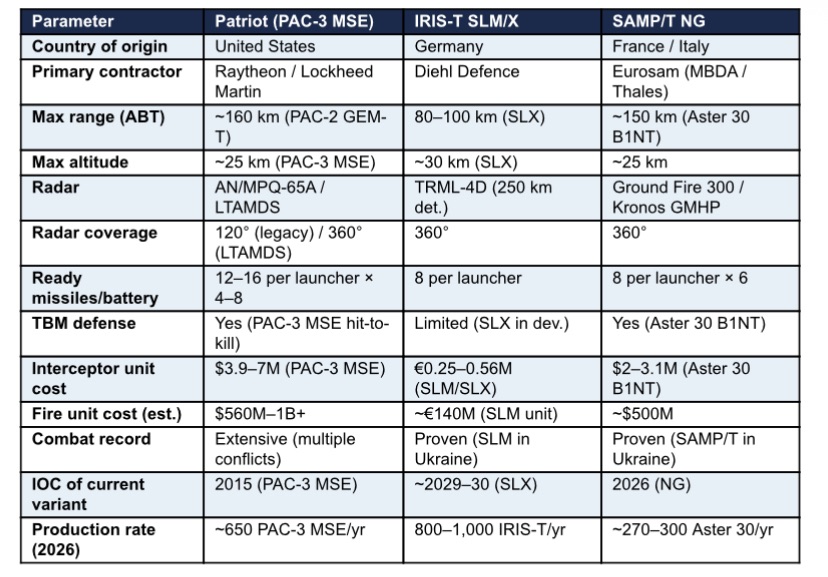
For longer-range and theater missile defense, France co-developed the SAMP/T (Sol-Air Moyenne Portée/Terrestre) system in cooperation with Italy, deploying the Aster family of missiles (Aster 15 and Aster 30), operational since the 2010s. These systems provide multi-role defense against aircraft, cruise missiles, and tactical ballistic missiles, bridging the gap between tactical air defense and strategic missile defense.
The Patriot Missile System: A Flagship of U.S. Long-Range Air and Missile Defense
Origins and Early Development
The Patriot system began in 1961 as a mobile solution to replace static air defense batteries like Hawk and Nike Hercules. Initially known as the Army Air Defense System for the 1970s (AADS-70s), it went through several renamings — SAM-D in 1964 and Patriot in 1976 — with flight testing commencing in 1969 and first operational deployment in 1982. The early system was conceived largely as a medium to long-range air defense missile system, designed to engage aircraft and cruise missiles.
Evolving to Ballistic Missile Defense
-
PAC-1 (mid-1980s): The first major upgrade to the Patriot incorporated software and hardware changes aimed at intercepting tactical ballistic missiles such as the Lance missile, shifting the system’s mission beyond traditional air targets.
-
PAC-2: This upgrade introduced improved missile fuzing, enhanced warhead capabilities, and extended remote launch capability, enabling broader area defense and improved effectiveness against early-generation battlefield ballistic missiles.
-
PAC-3 (early 2000s): Marking a significant leap in capability, the PAC-3 missile was redesigned around hit-to-kill kinetic interception technology. Rather than relying on warhead detonation near the target, PAC-3 missiles impact interceptors directly, significantly increasing kill probability, especially against sophisticated tactical ballistic missiles and cruise missiles. PAC-3 entered service in 2002 and remains a cornerstone of Patriot’s current configuration.
Operational Experience
Patriot batteries have seen extensive deployment in multiple conflicts — from the Gulf War through Iraq and Afghanistan to the ongoing defense support for Ukraine — with evolving performance metrics. Early Gulf War engagements showed modest success (around 25% kill rate), improving substantially with technological maturation to 90% or more in later deployments. The system is routinely integrated into broader missile defense architectures such as the U.S. Army’s Integrated Battle Command System (IBCS), enhancing situational awareness and engagement coordination.
Western European Developments: Indigenous Systems and Integration
Western Europe’s approach to long-range air and missile defense reflects a combination of national innovation and close collaboration with U.S. technology, particularly within NATO frameworks. Early reliance on U.S. medium and high-altitude systems like Hawk and Nike Hercules gradually gave way to the development of indigenous or jointly-developed capabilities.
-
Short and Medium-Range Systems: Countries like France and Germany developed the Roland missile system, tailored primarily for point defense against aircraft and tactical threats.
-
Long-Range and Theater Missile Defense: The SAMP/T (Sol-Air Moyenne Portée Terrestre) system, a Franco-Italian collaboration, typifies modern European long-range air defense, utilizing Aster-30 missiles with ranges up to approximately 120 km. SAMP/T addresses both conventional air threats and tactical ballistic missiles.
-
MEADS (Medium Extended Air Defense System): A tripartite initiative between the U.S., Germany, and Italy aimed at creating a next-generation system to supersede Hawk and Patriot systems with enhanced range and multi-threat engagement capabilities. Despite technical progress, MEADS has been scaled back or canceled in recent years, resulting in continued reliance on a mix of U.S. Patriot deployments and systems like SAMP/T for European missile defense.
European air and missile defense efforts emphasize modular, mobile systems that can be integrated into NATO’s overall missile defense structure, benefiting from combined sensor networks and command links.
The UK pursues a layered defense structure centered on several key systems that emphasize mobility, networked sensor integration, and adaptability to evolving threats, leveraging indigenous missile designs (CAMM) rather than adopting American systems outright:
-
Sky Sabre / Land Ceptor (CAMM family): Introduced as a replacement for the venerable Rapier missile system starting in 2021, the Sky Sabre system employs the Common Anti-Air Modular Missile (CAMM). CAMM missiles feature active radar seekers, soft vertical launch technology, and highly modern command and control capabilities. Sky Sabre serves as the British Army’s main medium-range ground-based air defense system, designed to defend key assets from aircraft, helicopters, drones, and tactical ballistic missile threats up to around 25-30 km
-
Sea Ceptor (CAMM-based): The Royal Navy’s principal surface-to-air missile system, Sea Ceptor, also employs CAMM technology, giving the UK’s surface fleet potent anti-air and missile defense capabilities with a common missile family enhancing logistics and interoperability.
Current and Emerging Challenges: Hypersonic Glide Vehicles (HGVs)
The advent of hypersonic weapons—especially hypersonic glide vehicles—represents a fundamental disruption in missile defense. Unlike traditional ballistic missiles that follow predictable parabolic trajectories, HGVs maneuver dynamically at speeds exceeding Mach 5 within the atmosphere, greatly complicating detection, tracking, and interception.
Western defense establishments, including the U.S. and key European allies, are actively pursuing research and development in several areas:
-
Enhanced Sensor Architectures: Development of space-based infrared sensors, airborne radar platforms, and advanced ground-based radar networks to provide early warning and continuous tracking.
-
Agile Interceptors: Missile designs with improved speed, maneuverability, and guidance technology are being tested to counter unpredictable HGV trajectories.
-
Integrated Networked Systems: Tight integration of sensor inputs into command and control architectures to accelerate decision cycles and enable multi-layered responses.
No fully proven operational hypersonic defense system exists today, but various programs focus on adapting existing systems like the Patriot and THAAD, complemented by future technologies tailored specifically for hypersonic threats.
The future
Looking ahead, the combined focus on sensor integration, multi-layered defensive architectures, and cutting-edge interceptor technology will remain crucial to maintaining effective long-range air and missile defense in an increasingly complex strategic environment.